The Algebraic Structures in Topology is a conference series that meets every two years in San Juan, Puerto Rico and this year is partially supported by the National Science Foundation, Purdue University, the Institute of the Mathematical Sciences of the Americas at the University of Miami and the K-Theory Foundation. The conferences will feature a variety of events focusing on recent developments in algebraic topology and their applications to geometry, physics, and data science. This iteration is an official satellite event of the International Congress of Mathematicians 2026 (July 23-30, 2026).
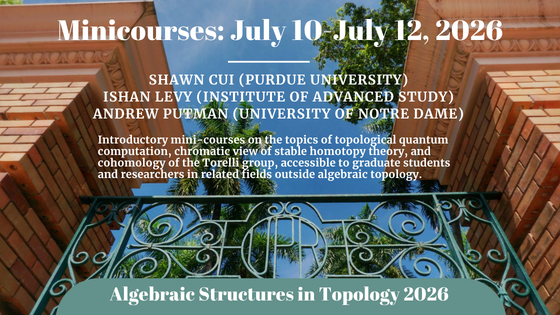
This year’s iteration of the series will occur on July 10 – July 17, 2026. From July 10th to July 12th it will feature three introductory mini-courses on the topics of topological quantum computation, stable homotopy theory, and the cohomology of the Torelli group accessible to graduate students and researchers in related fields outside algebraic topology.
Mini-courses (at Julio García Díaz building JGD-123)
July 10–12
Friday · July 10
| Time | Activity |
|---|---|
| 10:00–11:00 | Invited Lecture – I. Levy |
| 11:30–12:30 | Invited Lecture – A. Putman |
| 12:30–2:30 | Lunch |
| 2:30–3:30 | Invited Lecture – S. Cui |
| 4:00–4:30 | Contributed Talk – A. Waugh |
| 4:30–5:00 | Contributed Talk – A. Watkins |
Saturday · July 11
| Time | Activity |
|---|---|
| 10:00–11:00 | Invited Lecture – I. Levy |
| 11:30–12:30 | Invited Lecture – A. Putman |
| 12:30–2:30 | Lunch |
| 2:30–3:30 | Invited Lecture – S. Cui |
| 4:00–4:30 | Contributed Talk – S. Kim |
| 4:30–5:00 | Contributed Talk – U. Pal |
Sunday · July 12
| Time | Activity |
|---|---|
| 10:00–11:00 | Invited Lecture – I. Levy |
| 11:30–12:30 | Invited Lecture – A. Putman |
| 12:30–2:30 | Lunch |
| 2:30–3:30 | Invited Lecture – S. Cui |
| 4:00–4:30 | Contributed Talk – J. Kaufmann |
| 4:30–5:00 | Contributed Talk – M. Ji |
Ishan Levy (Institute for Advanced Study)
The Chromatic View of Stable Homotopy Theory
Lecture 1
The goal of this talk is to give an overview of the category of spectra and some
of its basic properties. We will take the point of view that the category of
spectra is a universal place in which algebra can be done.
Lecture 2
Work of Quillen and Novikov gives a deep connection between the category of
spectra and the theory of formal groups. In this talk, I will explain this
connection, and discuss some relevant structural results about formal groups,
such as the height filtration.
Lecture 3
I will explain how the height filtration of formal groups can be incarnated at
the level of spectra in two ways: as the chromatic filtration as well as a
finitary version of it. In doing so I will also explain some of Ravenel’s
conjectures, what is still unknown, and their connection to the homotopy groups
of spheres.
Andrew Putman (University of Notre Dame)
The Cohomology of the Torelli Group
Lecture 1: The Mapping Class Group and Its Finiteness Properties
This talk will introduce the mapping class group of a surface and discuss its
finiteness properties.
Lecture 2: The Torelli Group
The Torelli group is the kernel of the action of the mapping class group on the
first homology group of the surface. This talk will introduce the Torelli group
and explain some of its structure. In particular, we will give an introduction
to the Johnson homomorphism. One of the themes of this talk will be finiteness
and non-finiteness properties.
Lecture 3: Homological Finiteness of the Torelli Group
Recent work of myself and Dan Minahan shows that for surfaces of sufficiently
large genus, H2 of the Torelli group is finite-dimensional and
spanned by cup products of classes in H1. A very recent (June 11)
paper of Gaifullin gives a spectacular generalization of this and shows that
each Hk is finitely generated for g large (relative to k). I will
explain Gaifullin’s proof, specialized to the case of H2.
Shawn Cui (Purdue University)
An Introduction to Topological Quantum Computation
Lecture 1: From Quantum Mechanics to Topological Quantum Computation
We will review the basic ideas of quantum mechanics and quantum computation,
explain the challenge of protecting quantum information from noise, and motivate
the topological approach. We will then introduce the general framework of TQC,
anyons as its fundamental objects, and several important computational models.
Lecture 2: The Algebraic Theory of Anyons
We will develop the algebraic description of anyons using representation theory
and category theory. Topics will include fusion rules, braid group
representations, and the categorical structures that encode fusion and braiding.
Lecture 3: Universality, Simulation, and Topological Applications
We will discuss several central problems in TQC, including computational
universality and simulations between different anyon models. Time permitting, we
will also explore applications of topological quantum computation to topological
quantum field theory and low-dimensional topology.